
The thinking behind COFFEE HAZEL
Masaharu Kuriya — KURIYA COFFEE ROASTERS / SORAMAME LAB INC
In this article
- Coffee is the one bean that cracks twice
- First crack is a release of steam, not a sound
- Second crack is a different phenomenon altogether
- Why first crack is hard to detect, and what we did about it
Coffee cracks twice
Heat a coffee bean far enough and it cracks.
Ginkgo nuts do it, so do soybeans, so does corn — popcorn is the same idea. But coffee has something the others do not. Coffee is the one that cracks twice.
That is why roasters speak of first crack and second crack. The two sound similar. What produces them is not similar at all.
First crack is a release of steam
Here is what happens inside the bean as it heats.
- The bean first turns soft and rubbery. At the same time the water in its cells tries to expand, and the whole bean swells
- Then the cells reverse course and harden into a glassy state
- Heating continues. The water still wants to expand, but it is now shut inside hardened cell walls, so the pressure inside climbs
- At some point the cell walls give way and steam is released all at once — and that is what makes the sound
That is first crack.
First crack is the release of steam. The popping sound is only what comes with it.
First crack and flavour
First crack is a physical event: steam pressure breaks a cell wall. It is worth being precise about what that does and does not mean. Cracking does not, in itself, change how the coffee tastes. Flavour comes from chemistry — Maillard reactions, caramelisation.
But a physical event that changes the temperature and pressure inside the bean will change how those reactions proceed. That is why first crack matters: it is the point at which the conditions for the chemistry shift.
The stretch of the roast after first crack is called the development stage. The name makes more sense once you see it as the phase in which flavour-determining chemistry runs on, after the bean’s physical state has changed.
In light roasting especially, how long you keep applying heat after first crack is one of the main things deciding when to drop. Roasters will know this as DTR — development time ratio, the share of total roast time that falls after first crack.
Second crack is something else
By the time second crack arrives, the bean is in a very different state. Most of the water has gone. Thermal decomposition is under way inside. The cell walls have carbonised and passed beyond glassy into brittle. Those brittle walls fail under the pressure of gas that has built up inside — that is the current understanding of second crack. It sounds higher, finer and more continuous than first crack because the failures happen at a smaller scale, one after another.
The gas is mostly carbon dioxide from thermal decomposition, joined by whatever steam remains and by various volatile compounds. What decides when second crack happens, though, seems to be less the amount of gas produced than the structural change that brings the cell wall to its breaking point. Where first crack is a simple physical release of water, second crack is what happens once decomposition has run far enough — the same word, a rather different event.
| First crack | Second crack | |
|---|---|---|
| What happens | Steam pressure breaks the cell wall | Brittle cell walls fail under gas pressure |
| State of the bean | Still holds water; hardened, glassy | Water gone; decomposing, carbonising |
| The sound | Low and loud, intermittent | High and fine, continuous |
| Mainly released | Steam | CO₂, steam, volatiles |
| Meaning for the roast | Start of the development stage; the reference point for DTR | A marker for dark roasts; oil begins to surface |
The mechanism of second crack is, in truth, one of the areas of coffee science that is not fully settled. Few studies have measured precisely what acts in what order during a roast. That makes it worth digging into, and it is one of the things we at SORAMAME LAB would like to work on.
One more thing about second crack: around this point oil begins to appear on the surface of the bean. That follows from the collapse of the cell structure; it is not the cause of the sound. Surface oil is exposed to air and oxidises readily, and oxidised oil spoils flavour as well as being no good for you — so dark roasts taken past second crack want a little more care in storage.
Why first crack is hard to catch
Back to first crack. We have established that it matters. So how do you tell exactly when it happens?
Until now, almost always by listening. But how the cracking sounds depends heavily on how many beans are in the drum and what they weigh — which is to say on their size, their volume, their density. The sound is intermittent by nature: some beans crack clearly, others are barely audible. For something so important to the roast, the moment of first crack has been remarkably hard to pin down.
Measure the steam, not the sound
Recall what the sound actually is: a by-product of steam being released. If that is so, then observing the steam itself ought to place first crack far more precisely than listening for the crack. That is the idea SORAMAME LAB was built on.
We are a company that looks at coffee scientifically and turns what it finds into products, started by people around KURIYA COFFEE ROASTERS who share that view. COFFEE HAZEL is the first of them.
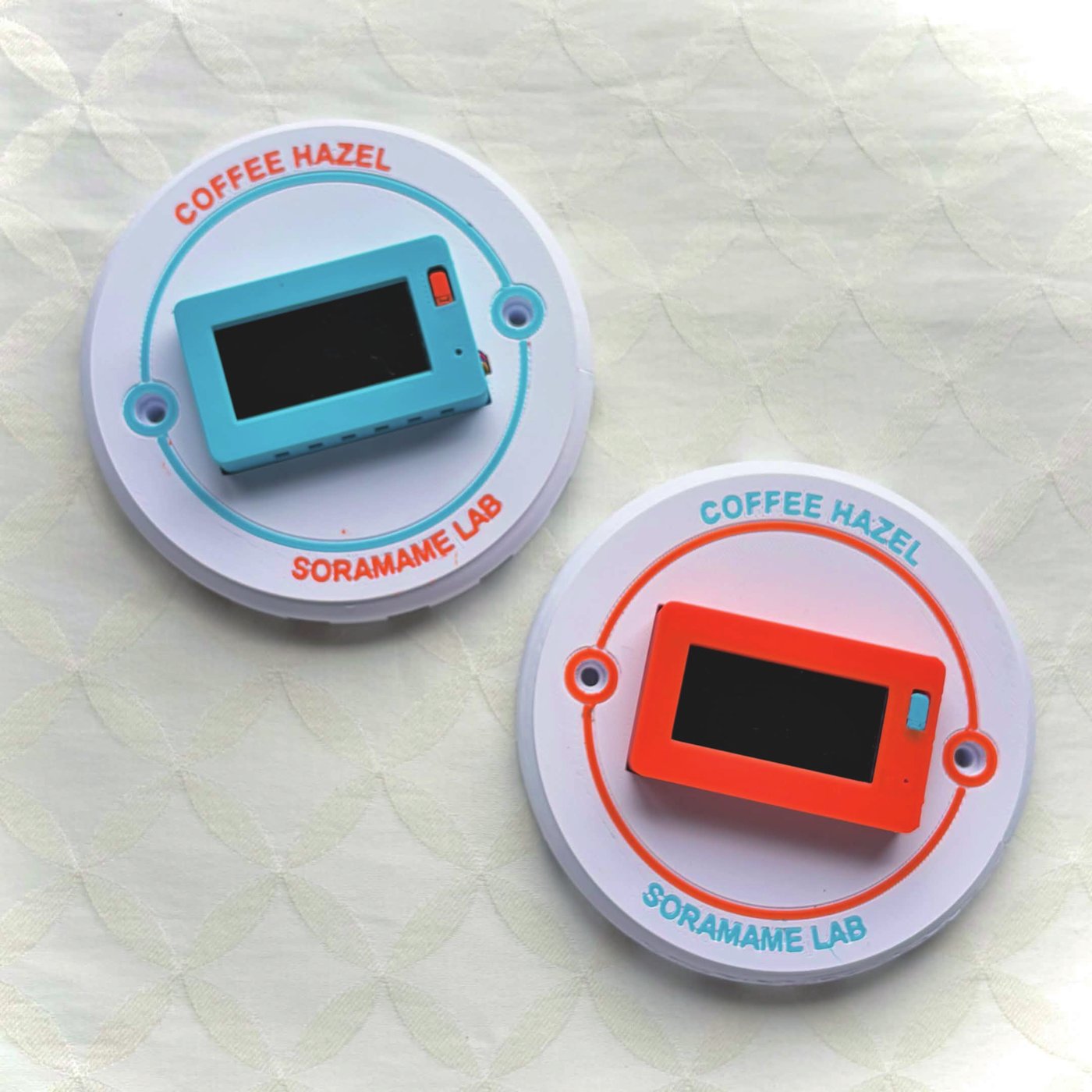
COFFEE HAZEL is a sensor that measures steam, together with a desktop application (patent pending). It works like this.
- A humidity sensor in the roaster’s exhaust duct measures the steam in the exhaust as absolute humidity (g/m³)
- Subtracting the absolute humidity of the room gives the water coming out of the beans, and nothing else
- That figure is watched continuously as a rate of rise
- When the rate of rise passes a threshold, the system declares first crack and tells you
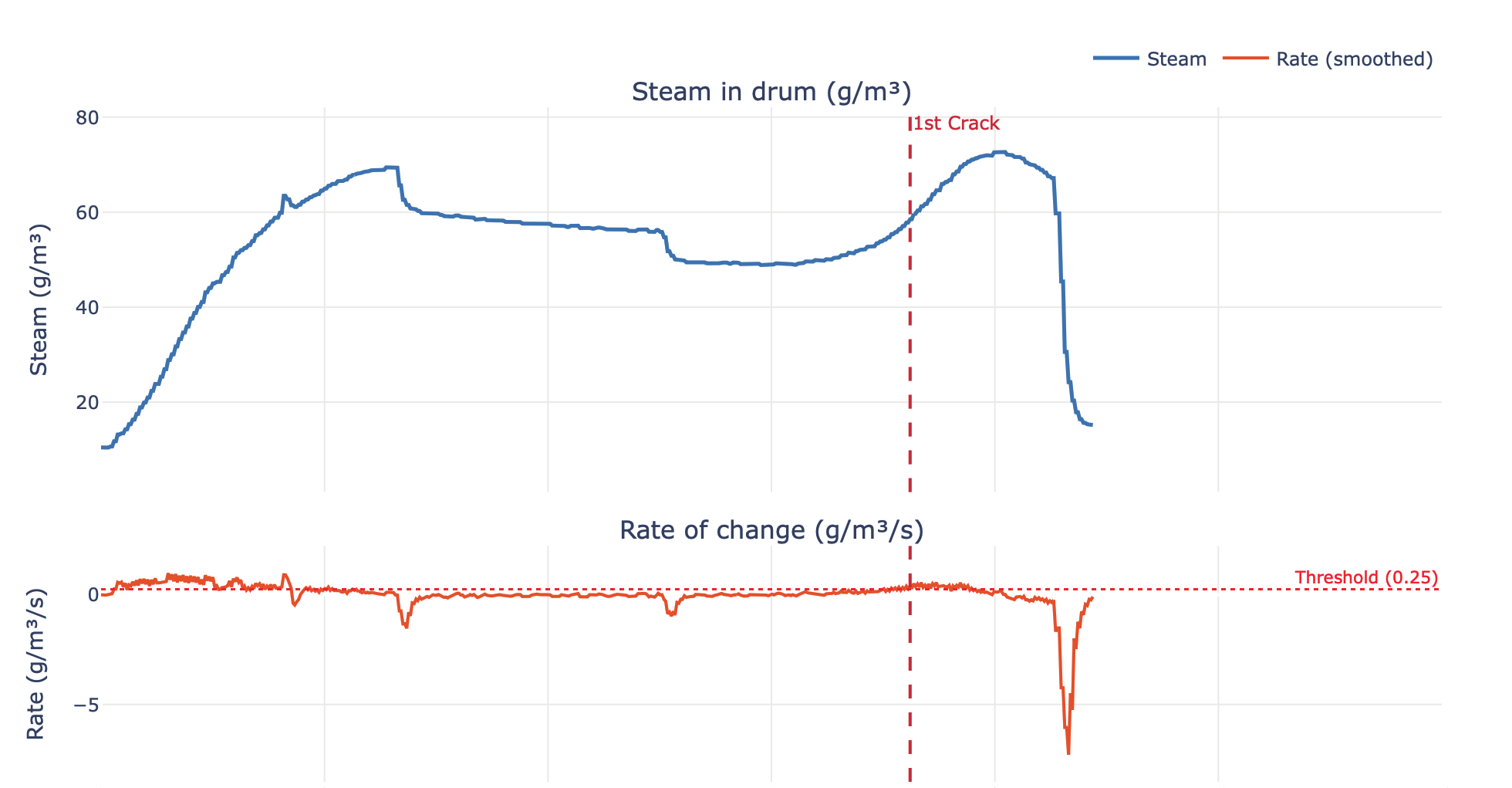
With COFFEE HAZEL you can fix the moment of first crack against a number rather than an impression. That makes a roast easier to repeat, which is what raises the quality of the beans, which is what makes the coffee better.